Showing posts with label swordfish. Show all posts

Wednesday, June 1, 2011

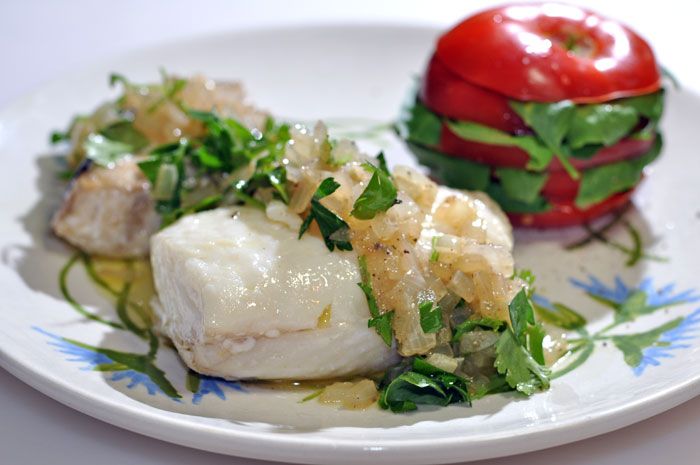
flounder and swordfish, tomato with basil


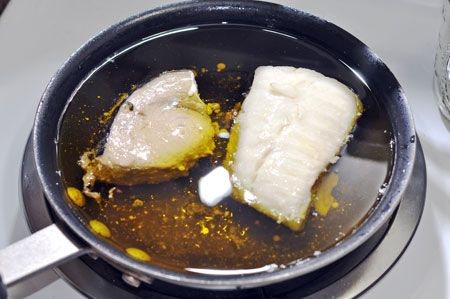
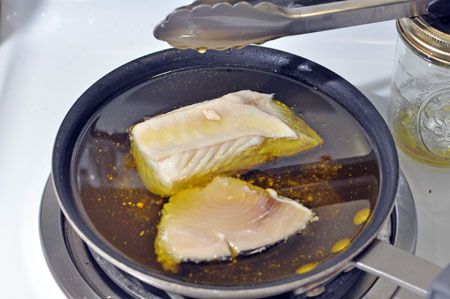
This is a piece of flounder and a piece of swordfish that was frozen, excess fish from a previous bouillabaisse. The two pieces were thawed then poached in hot olive oil that never exceeded 150℉ / 65℃. Okay FINE! The temperature got up to 165℉ / 74℃ but that was only in one spot and I quickly stirred it around and it went back down lower than 150℉ / 65℃. Both pieces cooked surprisingly fast. The oil was never so hot that the fish couldn't be turned with fingers holding the fish so the tongs could slip under. Seemed a little strange. The interior of the fish reached 135℉ / 57℃.


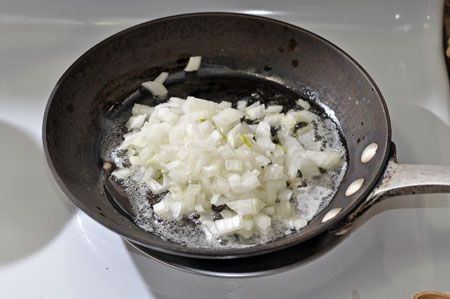
Chopped parsley was tossed into the onion sauce off the heat. 

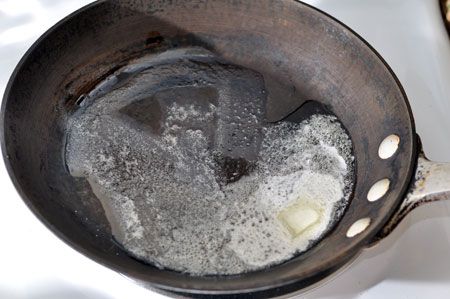
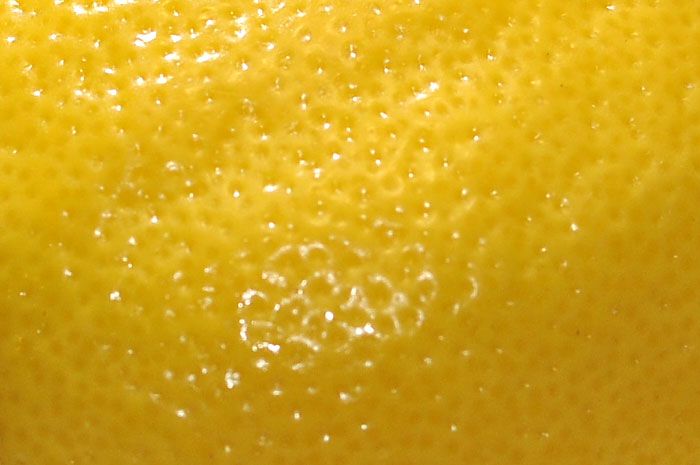
I could have been more refined about this sauce by processing the onion or possibly by grating it instead of dicing it. But I am cooking for myself over here and not trying to impress anybody with refinement. There is only lemon and oil, salt and pepper. Nothing at all exotic like lemon grass, star anise, or nam pla, whatever that is. 

*looks up nam pla*

Oh, fish sauce. I guess it's not that exotic. 
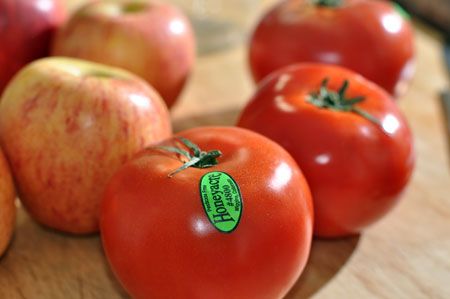

The sliced tomato with basil was seen on the cover of Jean-Georges book Cooking at Home With a Four Star Chef. Mark Bittman coauthor. I suppose it should be noted the four stars are awarded by the New York Times, not Michelin. 

I did not read the recipe for the tomato although I did notice other photographs of it inside the book when I flipped through. Seemed simple enough by appearances. Oh! The chef's version of the tomato is sitting in a puddle of some kind of green sauce. That's probably important. 


This book is neato-mosquito packed with lots of great ideas. Everything looks simple with just a few exotic ingredients. I bought the book used at a discount on Amazon. I only paid a few dollars for it, possibly six or seven, I forget. Whatever, it was totally worth it. Not everything is photographed. there are a lot of great color photographs of about half the recipes, maybe less. There are more black and white photographs of chefs at work and artistic restaurant snaps of things going on that interested the photographer. It's a bit frustrating because all of that extra black and white photography stuff is unattributed. The photographer is attributed but not the subject. The reader has no idea where these things are taking place. I should say the flipper-througher has no idea, maybe all that is explained in the introduction which I haven't read yet. 


coriander seeds

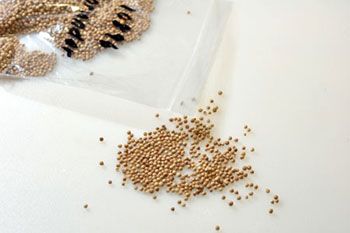
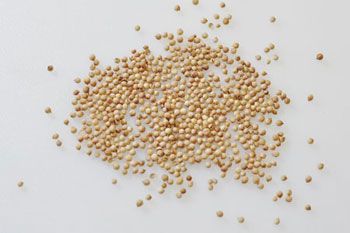
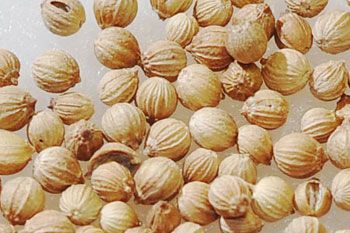
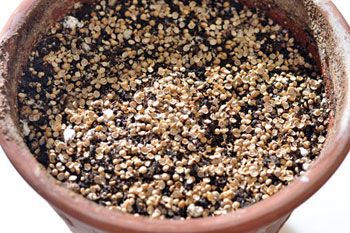
These are regular coriander seeds found in the spice section of any grocery store. These particular seeds are from the bulk section of Whole Foods, but they could be anything. When these particular seeds were smashed, they tended to break into hemispheres. That did not happen the previous time I smashed coriander seeds. That time the seeds broke into irregular pieces with approximately the same amount of debris. I have no idea how old these seeds are but they appeared to be breaking apart on their own. They separated with very little effort. I got the impression they were exceedingly dry and possibly old. So, there seems a big chance the seeds might not germinate.

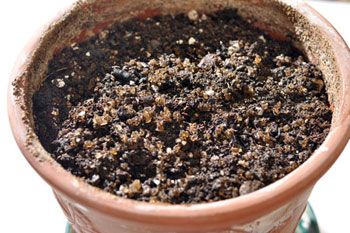
This is June 1, 2011. You'll see these photos again if the seeds germinate and if the plants grow. 
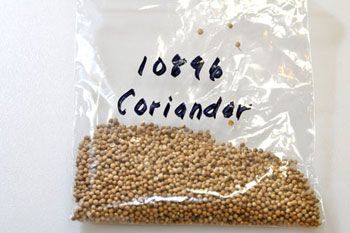


Each round coriander pellet is actually two seeds. That is why two plants emerge from the same spot when the pellets are planted without breaking off the outer shell. The outer shell tends to delay germination. You can see how that would spread out germination across a season and possibly even across seasons. 
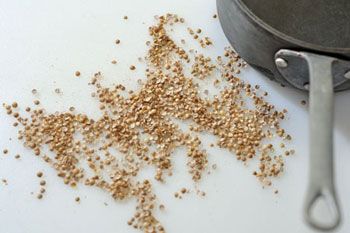


The smallest sauce pot I own was used to press the seeds. The pot was rolled over the seeds with slight pressure. That's all it took to break these particular seeds apart. When the pot stopped rolling as if on ball bearings, then pressure was stopped, the surface tilted to cause whatever round seed remaining to roll off, then those separated seeds were smashed apart too. 

All the seeds and all the extra debris was spread evenly over the top of wet dirt and gently pressed in then covered loosely with damp dirt. No attempt was made to sort through for proper seeds. The pot was covered with plastic kitchen wrap to hold in moisture. 

Thursday, May 5, 2011

swordfish, couscous


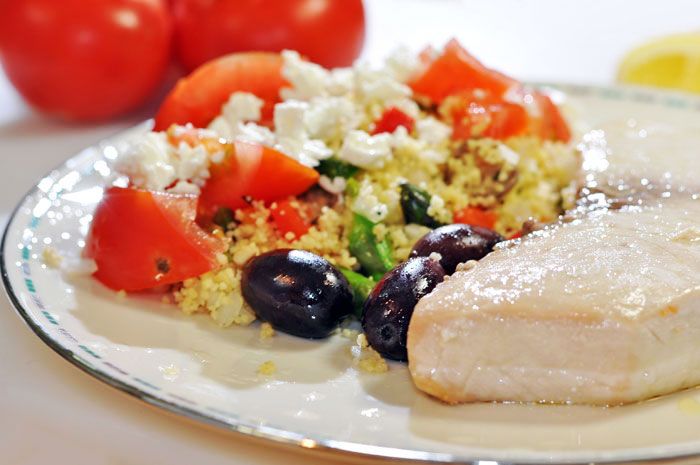
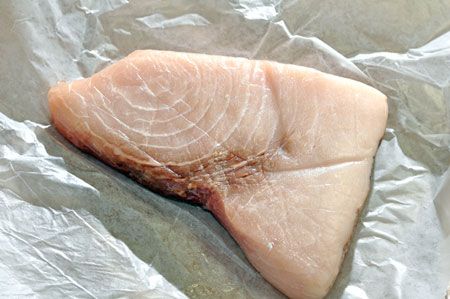
This is swordfish picked up from the market today. I did not ask, but I have no reason to doubt it was previously frozen as part of its ordinary processing. The small flounder filets yesterday were so extraordinary, as far as tiny flounders go, that I wanted to try again poaching in oil on low heat but using a thicker piece of fish this time. This too worked beautifully, and now this is my favorite way to prepare fish. The problem is, it takes a lot of oil and I hate to waste it, so another jar of olive oil must be retained specifically for poaching fish. 

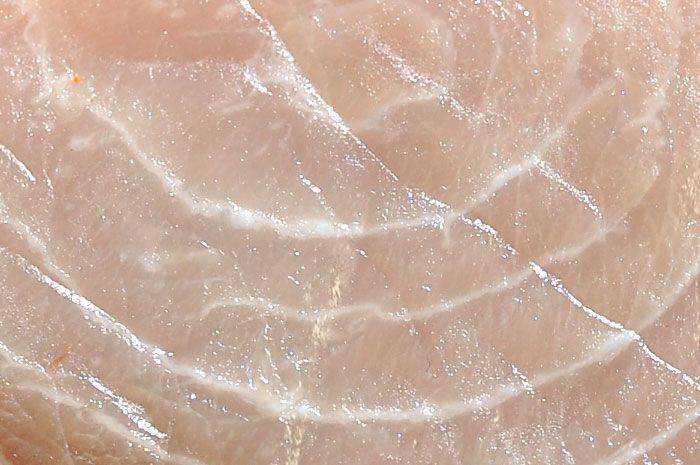
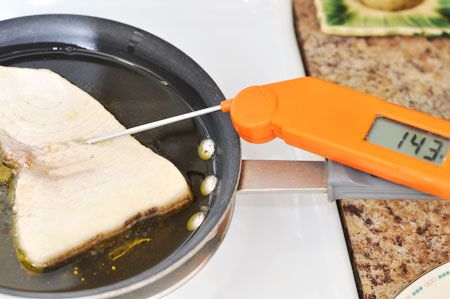
The oil never exceeded 180℉ / 82℃, mostly around 175℉℉ / 79℃, and the internal temperature of the fish section was gently raised to 145℉ / 63℃. These were not target temperatures, they're just the temperatures that happened by experimentation. I was looking for the fish flesh to denature, to observably change from shiny-opaque to whitish-opaque. The swordfish did bubble very slightly while poaching, but it never sizzled nor did it pop. 


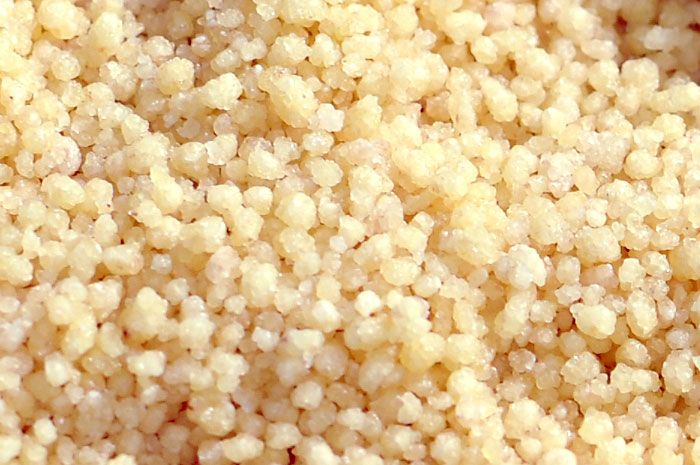
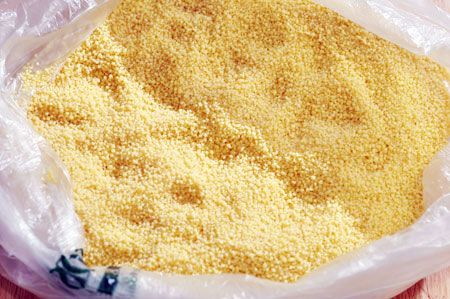
Couscous from the bulk bins at Whole Foods. How I love those bins. They're fun! You can wander around the bin section wondering to yourself, "What in the heck is this?" Then ask somebody. I yak it up with people. I ask them, "What is that you're scooping?" Then they tell me. They're always very nice. Maybe I'm annoying. 

Did I ever mention the time I was looking for anchovies in the import aisle, the Italian type anchovies packed in salt, but all I could find was the kind I already had at home in little jars. I asked a woman in the aisle if she happened to see anchovies. She smiled, approached me and began looking at the same spot I was already looking. She walked right up to me through the edge of my personal space. Then much closer than people usually approach. I dipped down to a lower shelf. She dipped down too. I rose back up. She rose back up. I moved down the aisle. She moved down the aisle. Had she been a Belgian Sheepdog I would have understood the close by heeling position but as it was I never experienced a woman do this, a perfect stranger, attach herself so closely to my person out in public. Was it my imagination? I moved back to the original spot, she matched my movement. I went back down the aisle again, she went back down the aisle. 

She's smelling me! 

How late I am to the realization. I had spritzed a spray of Antonio Banderas' Blue Seduction under my knit shirt before I heading out. It is a very light eau de toilette, barely noticeable actually, which is probably why she tagged so closely, having given her a reason to do so. I always thought of the cologne as citric, but looking at the ingredients now it's all regular spices with nothing at all exotic. I usually avoid scents, but that single reaction caused me to elevate the cologne to my favorite. 


Classic couscous is a labor intensive process of dampening semolina and rolling it in the hands to form pellets that are then coated with regular flour and then sieved. The particles that fall through the sieve are processed again. Semolina is wheat that is cracked by rollers. The space between the rollers is adjusted to be slightly smaller than the wheat grain. The bran and the germ of the wheat is flaked off while the endosperm is cracked into coarse pieces. Sifting separates the particles from the bran resulting in semolina. Then the semolina is ground further into flour. 

Modern couscous is already steamed then dried. So it's instant! This bears very little resemblance to classic couscous, but hey, it's who we are. Deal with it. To prepare, mix 1.5 parts boiling water to 1 part couscous, along with anything your little heart desires. Com'on use your imagination.

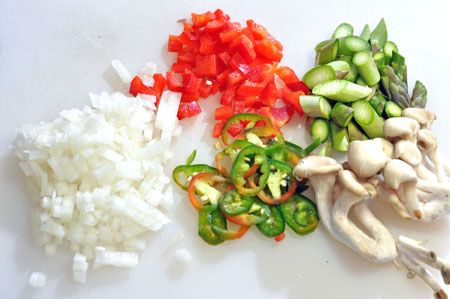
Some of these diced vegetables ↓ are heated in olive oil first, some of them are not. It was a matter of impulse. They each could have been heated, they each could have been raw. 


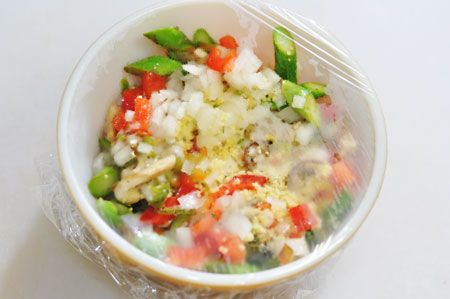
The ingredients are combined, the hot water added, then covered tightly for 5 minutes. 


Then fluffed. This small bowl was full and insufficient size to handle the expansion of fluffing. The contents were transferred to a larger bowl, vigorously energetically fluffed, seasoning adjusted, then plated. When the remainder was returned to this original bowl, it completely filled it. Like magic. It was like the miracle of loaves and fishes all over again except couscous this time. "Lord, why dost thou perplexeth me so? Dost thou exerciseth thine creator prerogatives and playeth thine Lordly games with mine tender human sanity? "


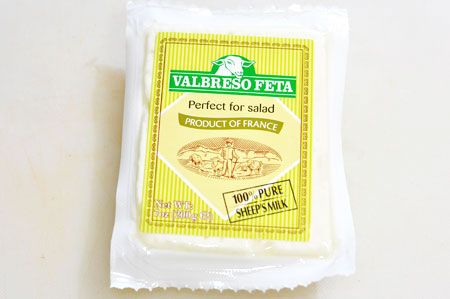
I thought feta was cheap, but it's not. Most of what was available was goat cheese. For some reason sheep cheese seemed nicer. Sheep are fluffy and nice, goats are are kind of gross, so I went with sheep. Do you ever see plush toy goats? No, you don't. But you do see plush toy sheep so even kids know sheep are nicer than goats. 

Plus, once my brother and I went into a Middle Eastern grocery store to explore. I had already been in there before and upon entering right by the front door I opened up a freezer cabinet expecting ice cream or popsicles inside but instead there were a couple of frozen sheep heads and sheep eyeballs staring deadly back up at me. I nearly pooped myself. I wanted my brother to poop himself too so I convinced him to stop in there with me and explore, but I was totally bummed out to see they removed the freezer and there were no freaky sheep heads to be seen anywhere. 

Instead we tried samples of their feta cheeses. The guys were so friendly, they kept giving us more and more samples until we tried them all. Then my brother was ready to skip off. I go, "Dude. These guys aren't in the business of handing out samples. We gotta buy something." So we bought some of each. We agreed that we liked the French feta best.