Showing posts with label culture. Show all posts

Tuesday, December 16, 2008

wheat grain

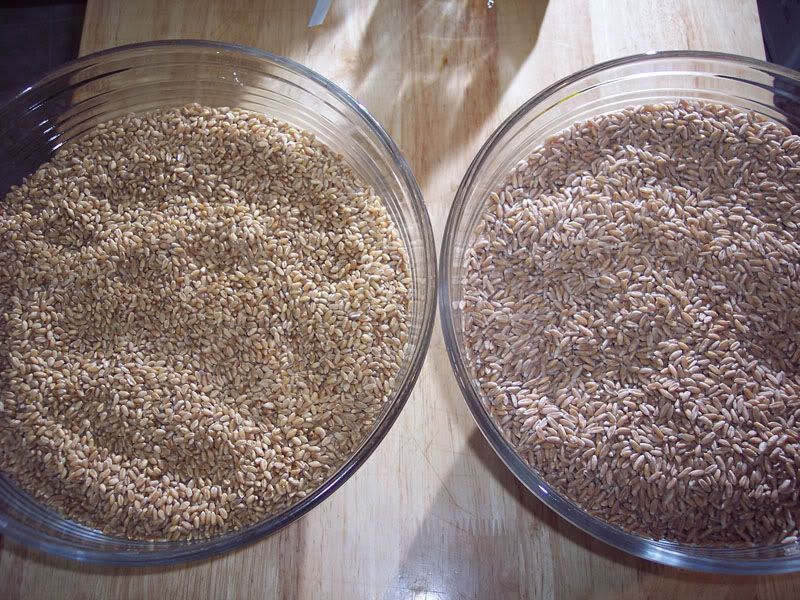
This week, the bins at my nearest Whole Foods contained only two types of wheat grain along with a few other more exotic types. They all suited me. Their protein value are all greater than so-called all purpose flour and so are perfectly suited for bread. I decided on a soft white spring wheat, as opposed to a hard red, of the two wheat grains that were available, and spelt, which is an evolutionarily earlier type that doesn't release its husk. Fine with me, if it doesn't release it's husk, I'm keeping the husks anyway. That's my new thing, I'm into husks. These two types of grain, the wheat and the spelt, were milled together. The last time I milled, I decided the flour was too fine, too indistinctly whole-grain, so this time I backed off a little bit. It's still a little too fine to suit me. I'm only about 1/3 of the way done. The machine began to heat up and I didn't want heat to be introduced to my tender flour so I shut it off. The collection bowl was completely full. I stopped just in time, otherwise, I don't know what would have happened if I ran it past the mill's capacity to hold the milled flour and began backing up. Can you imagine?

wheat and spelt
wheat and spelt close up

milled flour

I was chewing those spelt grains while I watched the mill work. It sounds like a very loud vacuum cleaner. When it's shut off, it sounds like a jet engine firing down.

The NorthWestern sourdough starter was removed from cold storage and revived. It's in the form of a wad of dense yeast cake. It weighed 4 oz so it was replenished with 4 oz of water and enough of the milled flour to form a thick paste. The milled flour, above, which is whole wheat (and spelt), will ultimately constitute no more than 1/3 of the total amount flour to be used to form the loaves of bread. But for now, the exhausted yeast is feasting on unadulterated whole grain. As such, even though the yeast culture is tired and nearly dead, it will be competing with yeast already present on the grain that was milled. They're going to have a war, these two cultures of grain, the wet cake, and the dried piggy-backing organisms, both in hibernation up to this point but now abruptly awakened and revitalized, and the NorthWestern culture will prevail in this conflict by sheer force of numbers. Although nearly dead, it's not totally dead, and it's numbers are concentrated. The piggy-backing yeast and bacteria is not concentrated, so it will lose the yeast competition, although some organisms will probably survive and be inducted, impressed if you like, into the NorthWestern army of campaigning organisms. That's the way I see this inside my head. In real life, it's probably nicer than that.

northwest culture

northwest culture fed

Monday, December 10, 2007

sourdough bread

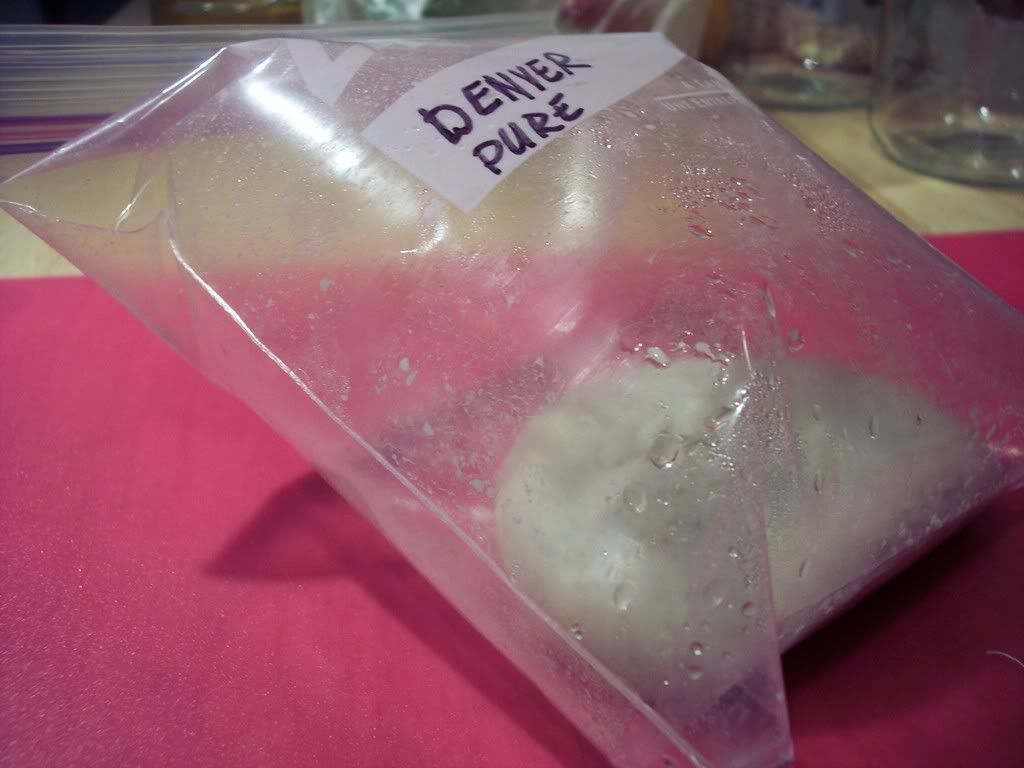
Denver culture.

Removed from refrigerator, over a few hours the reserved culture inflates the bag.↑

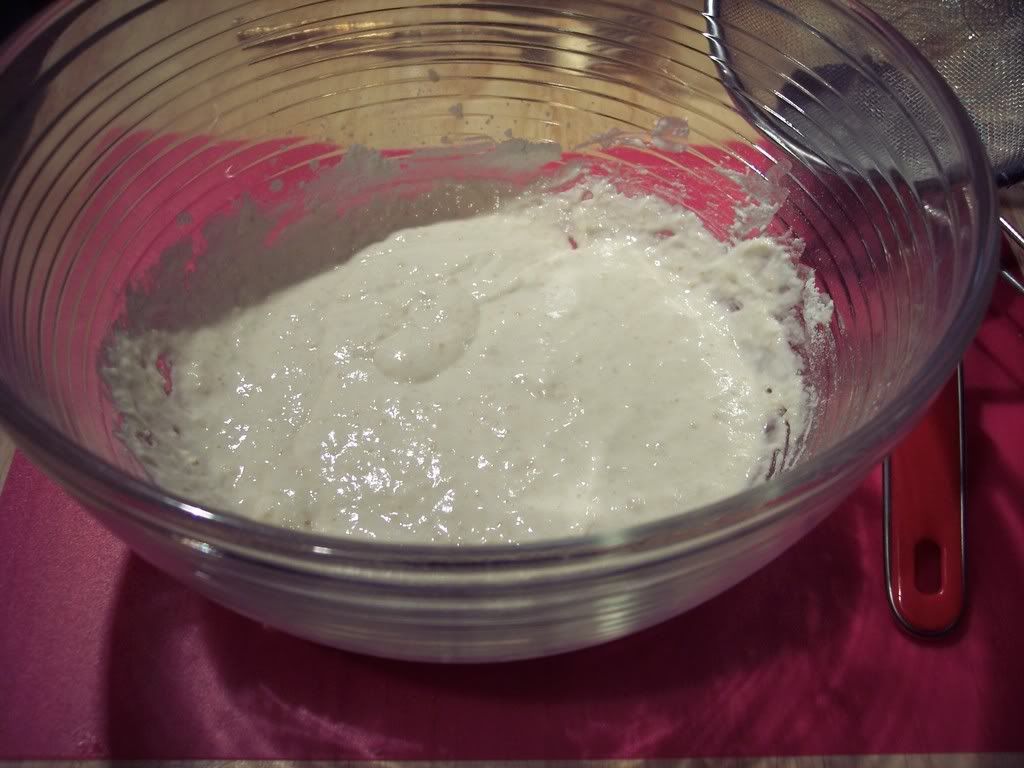
Fed 1 cup water + 1 cup flour↓


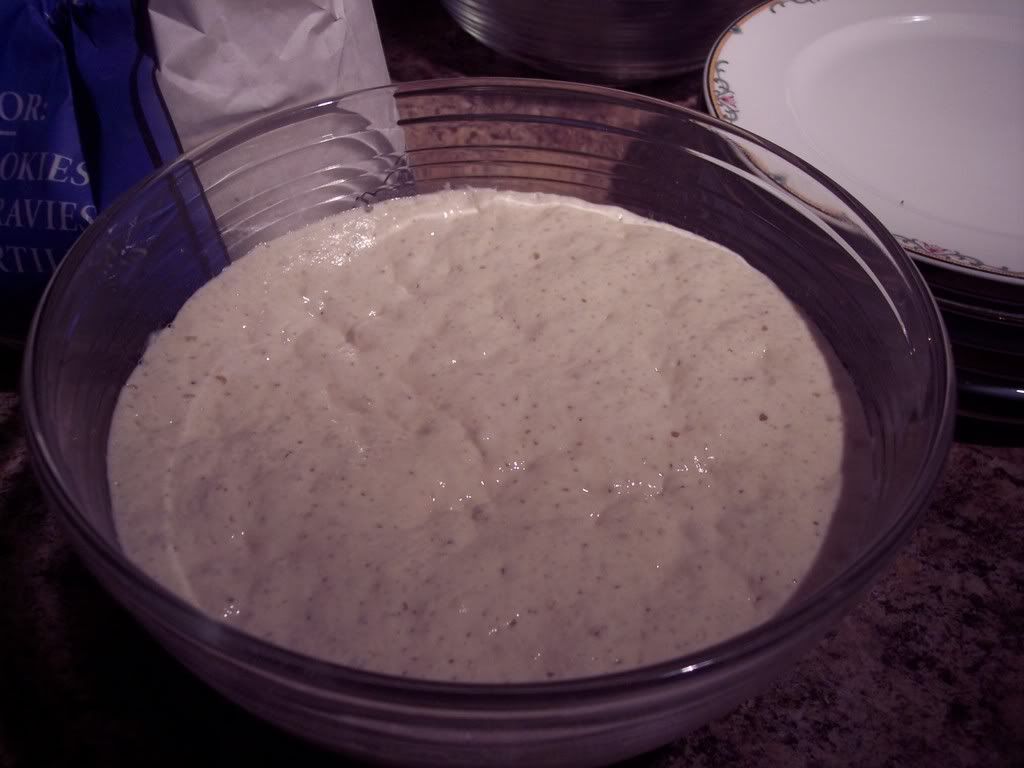
Fed 1+1/2 cup water + 1+1/2 cup flour
and about four hours went by ↓


This was weird. The sponge for this batch was chilled before its final proofing immediately after mixing to arrest its rising activity while it ages. The sponge, instead continued to rise throughout the chilling procedure so it was pretty much entirely spent by the time it was removed for actual proofing. The yeast culture seems particularly suited to cold temperature, so the next attempt to arrest the culture's proofing will have to be done at temperature even lower than a refrigerator.

Saturday, November 17, 2007

bread 2

Saturday 1:00 pm A mixture of flour and water was sterilized. Looked like pancake mixture, enough to top one cup. Used steam and boiling water. Nearly boiling, 180℉, sufficient to kill hitch hiking organisms. The mixture is in a bowl, placed on outside patio, 5th floor, faces West, protected N. and S. walls. Temperature moderate considering it's late November. Covered with an upturned strainer, like a tight screen hat.

Friday 9:00 pm Nearly one week on the patio. Seems longer than that. Maybe it's nearly two weeks. The weather was cold. The sample froze a couple times. It was brought in to warm up then put back out. It was held inside a few nights to prevent further freezing. The sample is weighed and a fresh sample of equal weight is prepared. The two samples, one the collection, the other with fresh flour, are left to incubate with a low wattage incandescent lightbulb.


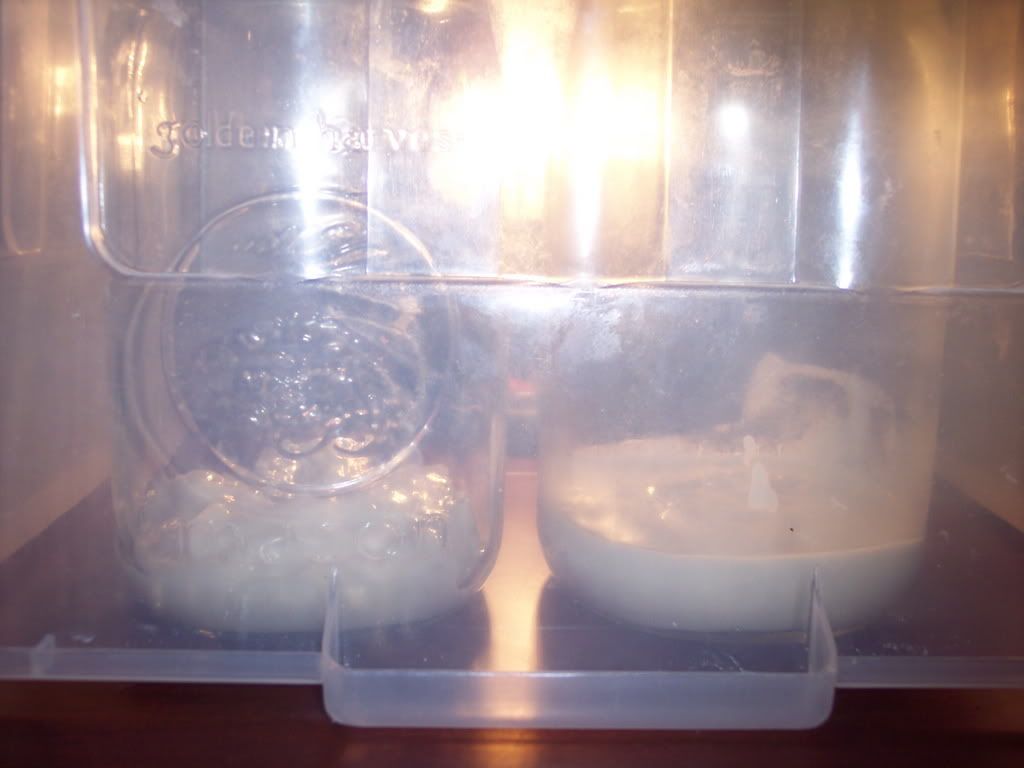
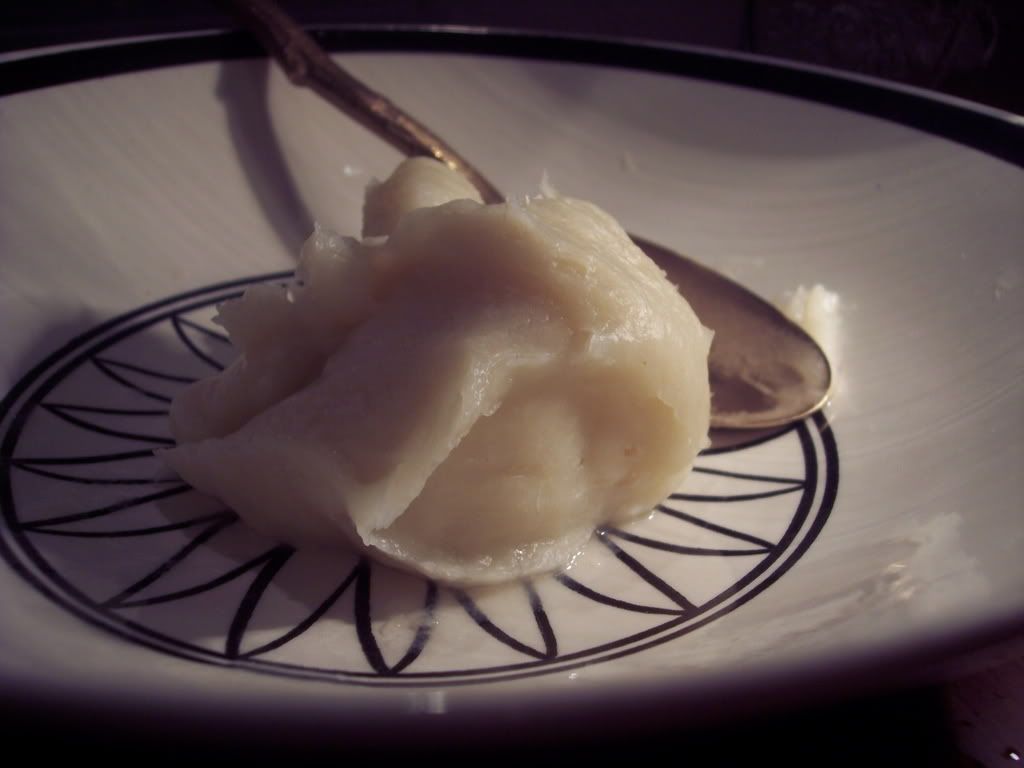
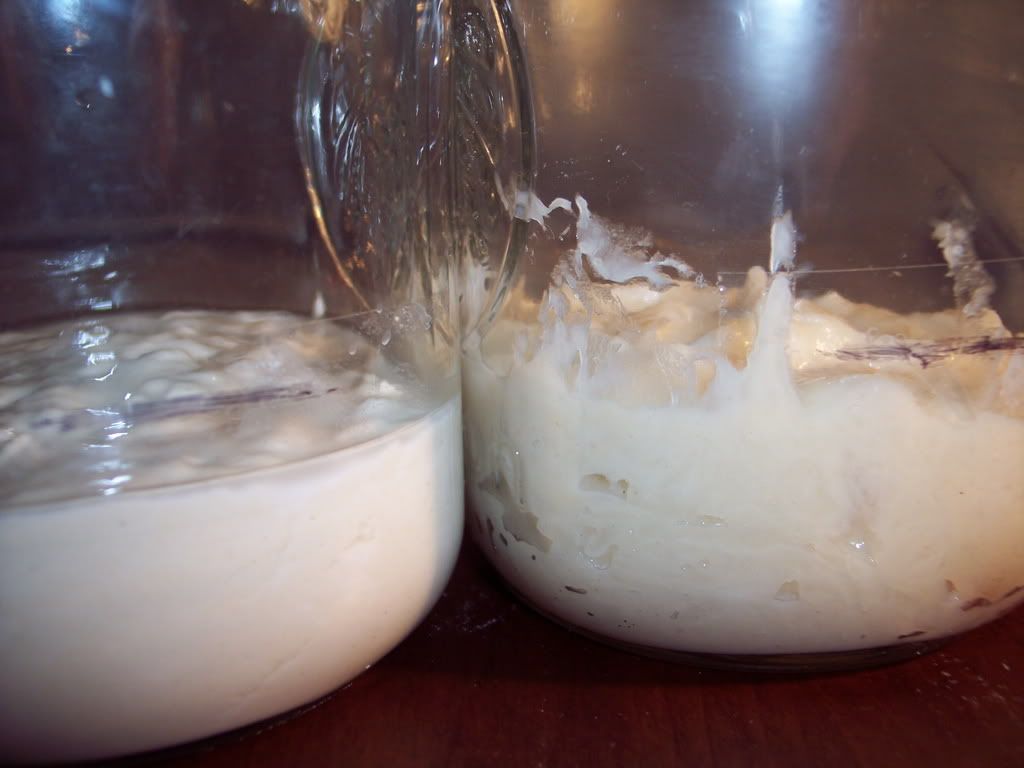
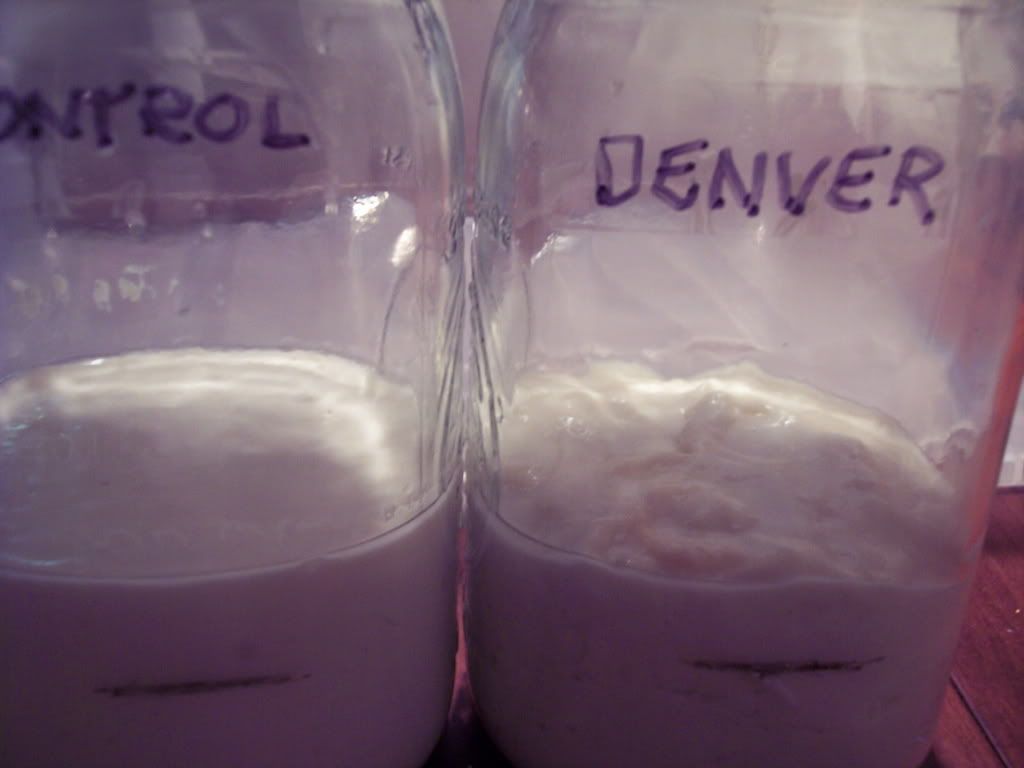
Saturday 11:00 am As found 14 hours later. Denver sample on the right. Both have reacted with cultivation, the Denver sample creating different type of bubbles in the cooked flour than the control sample with raw flour. Click photo to examine bubbles. The texture of the control was much closer to the gelatenous texture of other sourdough cultures.
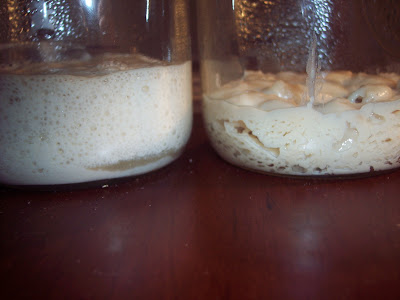

Both sample were fed and left to incubate further.

Denver sample feed scalded flour so it's limited to the organisms picked up locally.


The control was fed raw flour.
ControlDenver


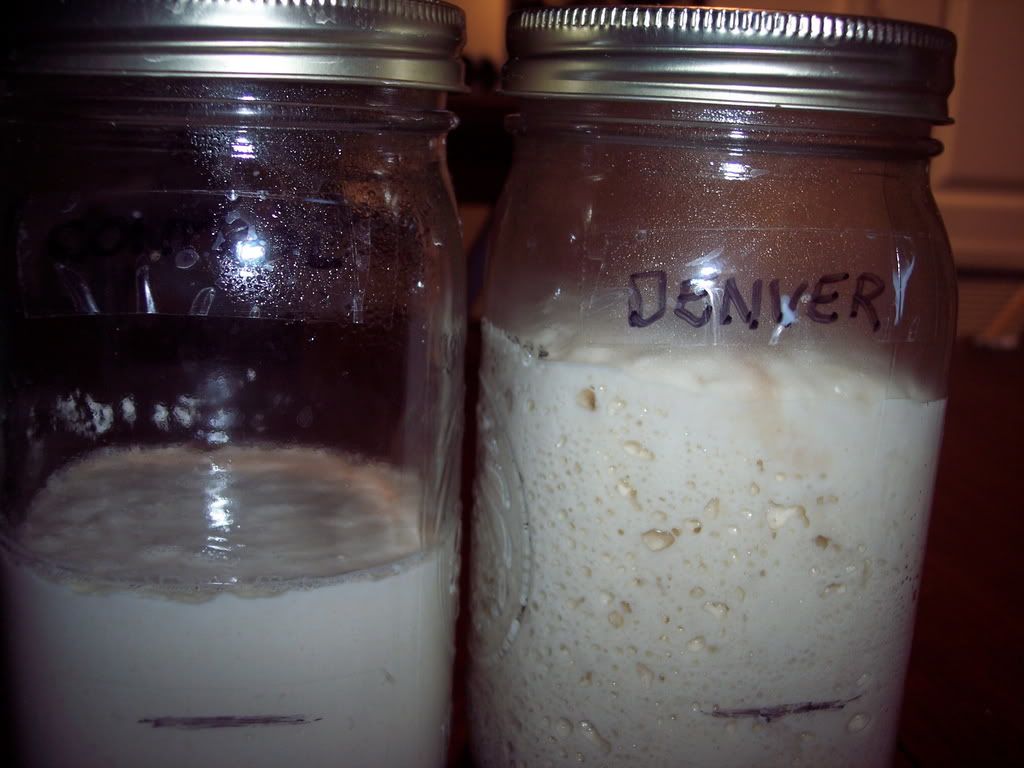
Saturday 11:00 pm 12 hours later, 26 total hours with low wattage bulb. ↓ The Denver sample had a strong alchol odor, rather pleasant, complex and sweet. The control sample had a one-dimensional raw odor.


Now everything has changed. Both cultures contain high concentrations of active culture, although they behave differently in cooked and raw flour. Now, the same amount of both samples were fed the same amount of the same raw food.

Left alone to ferment, or proof at room temperature. ↓ The Denver culture is now contaminated with whatever yeast and bacteria is piggybacking on the flour that has already proven to amenable to cultivation. We're counting on the numbers of organisms in the Denver culture are great enough to completely overwhelm or assimilate any piggybackers.


Sunday 1:30 am 2 and 1/2 hours later, Denver culture completely overtakes control.


7:00 am Sunday Both samples appear to have peaked.
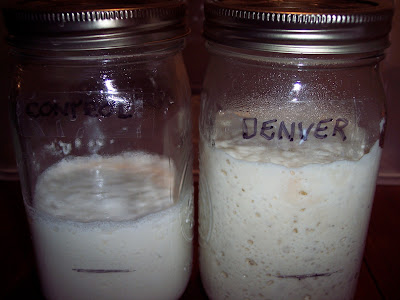

The Denver sample is doubled with fresh raw food, 1 Cup room-temperature puffed up starter → 2 Cups flattened out, whipped-up-in-the-mixer-and-still-there freshly feed starter.

The Denver culture is now a proper sourdough culture. The washing out, or purifying-of-the-sample phase, in which a tiny portion is used to inoculate a whole new batch, is omitted, therefore the present culture contains any and all airborne impurities that found their way into the collection.
I don't care. It passes the smell test and that's fine with me. The control will be tossed. At this point there's nothing to recommend it and I already have volunteer starters from controls of previous experiments that are pleasing and demonstrated more virile qualities.

This culture is fast. The 2 Cup mass rapidly filled the mixer bowl. It was fed 2 Cups water and however much flour made a dense sponge. It filled the bowl within an hour. Knocked down and chilled over night.

6:00 am MondayRemoved from chill. The bowl tried to overflow but it was covered. This messed up the top.

Added 1 egg
6 flax seed capsules flax seed oil (discarded capsules)
2 TBS wheat germ
1+1/2 TBS salt

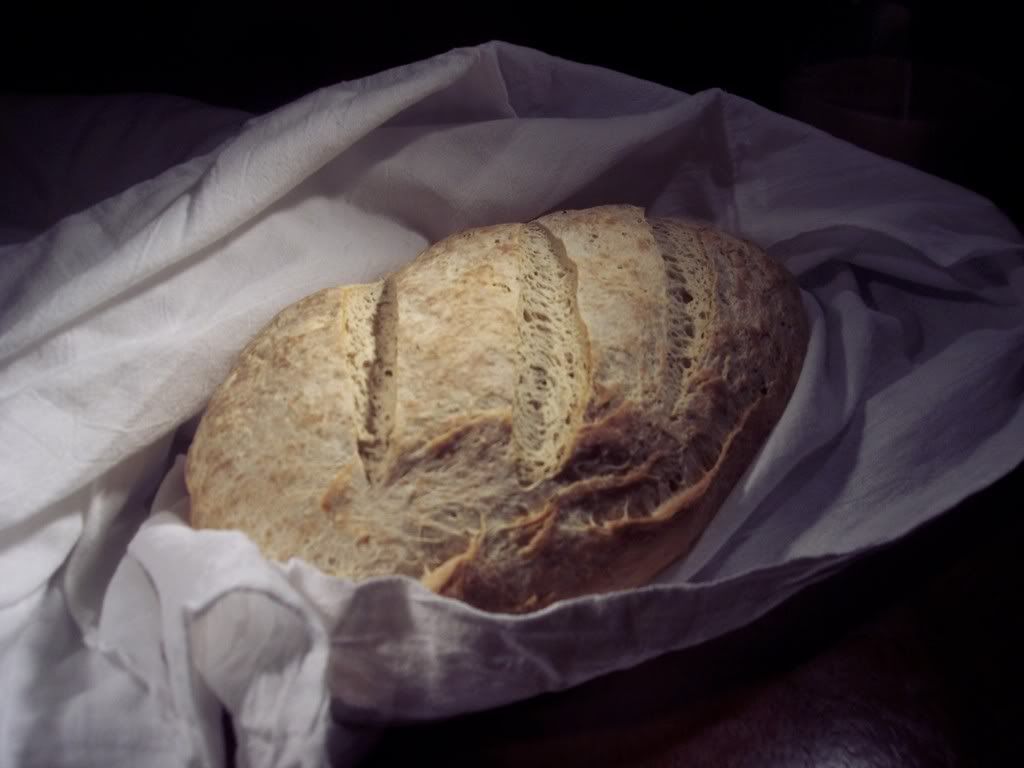
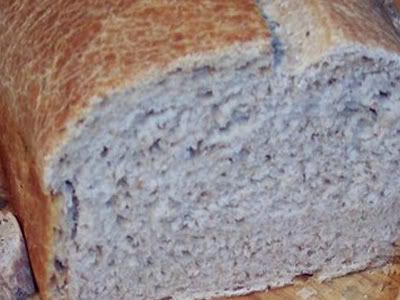
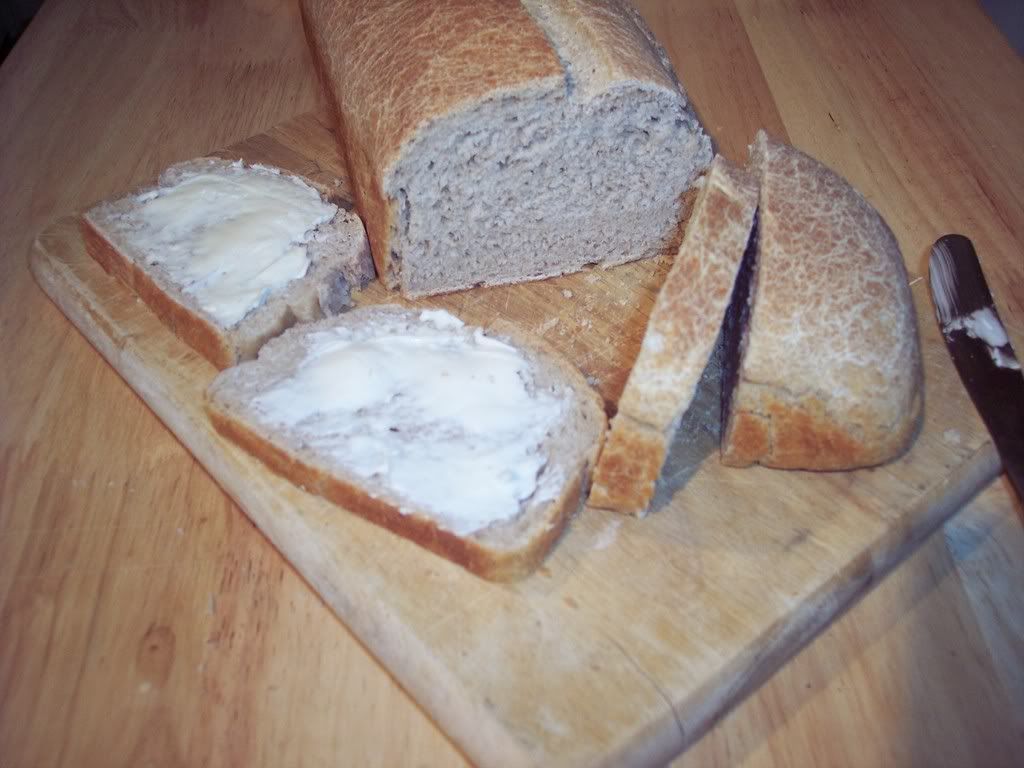
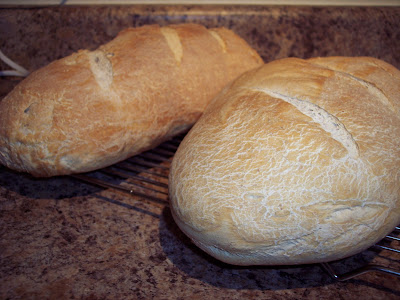
Overproofed at 4 hours. Baked on high for hour + 5 minutes.
Tuesday, November 13, 2007

sourdough starter Volunteer

The amazing hitch-hiking sourdough starter


The organisms making up the yeast culture were on the grain that was milled for this bread. Its story as a sourdough starter is told at length here (as the uninoculated control culture, the ignored other jar) and as a proper bread dough here

The place where the grain was grown is unknown, presumably Nebraska, but wherever it was, its yeast culture tastes fantastic. I will keep it and call it Volunteer.