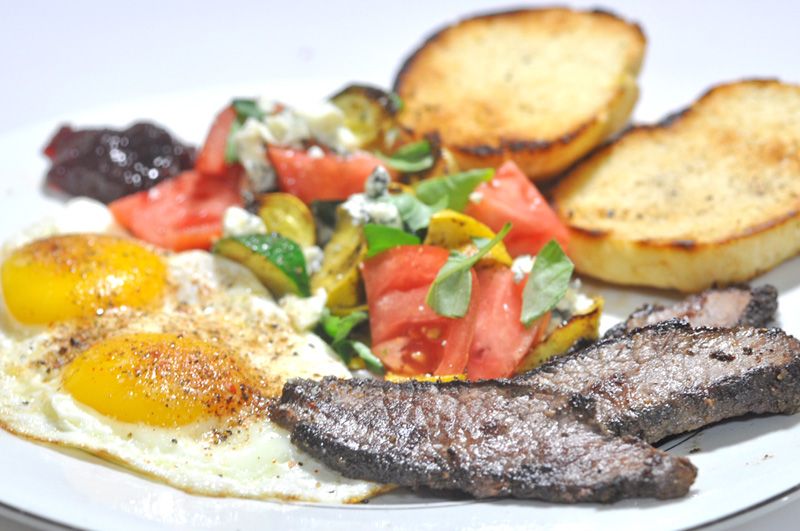
Flatiron held over from a previous meal described here.
Okay, here's the dealio. The yellow squash and the zucchini are baby specimens from plants like this:


Those plants are very similar. The chief difference between them is color. Baby specimens are chosen because those do not yet have seeds. They also tend to be less bitter. Plus they're a convenient size. They were combined with tomato which grows on a plant like this:

The fruits of those plants, vegetables if you must, were rolled as they were cut to result in irregular shapes which the cook prefers to steady discs which in the cooks view are boring. They were flavored with basil which grows on a plant like this:

So that's that for the vegetables, which usually one does not see at breakfast in the United States, and that is a cultural thing that does not make any sense in a society that apparently prides itself on knowing how best for everybody else in the world to live.
The bread was made mostly of flour that comes from wheat grain which is the seeds of a grass plant that look like this:

Which was leavened by hyperkinetic yeast cells which are strange microscopic organisms that lie somewhere between a plant and an animal and which replicate rapidly under ideal conditions in three very different ways due to the cells unique property of containing two full sets of DNA along with other outstanding survival propensities. One method of replication, the most common, is asexual, by duplicating its double-dose DNA within its own cell structure and then creating a wall between itself and the new bundle of DNA a bud results that is a clone attached to the original. The other method is sexual wherein either a single strand of DNA is sent off packing to unite with its opposite corresponding strand of DNA that was sent packing from a different cell, or sexually by sending off a full double-strand set to unite with a corresponding double set of DNA that was sent off from another cell. In either case the result is not a clone. But it may as well be, they are so much alike. The third method used by yeast cells to duplicate does also account for their stupendous ability to survive extremes that would kill less adaptive organisms, and for this they have our respect. Under duress, the yeast cell can shrink upon itself and form a hardened wall around each individual strand of its DNA, break apart its two complete sets, that's four strands in total, and wait out the trial, being blown hither and yon, being lifted into the high atmosphere, chilled to freezing, and then at last, after an age, finally dropped by the whirlwind into a moist warm spot that is favorable to loosening the shell it had formed earlier for survival, whereupon it eagerly seeks to use available material to duplicate its single strand DNA into a double-strand set of DNA and to do that again and again, to both bud from itself and to send them off to unite with other available single and double-stranded cells. It's an awesome sight to behold, and a real thing of beauty. This is why bakers stretch the dough and fold it. It facilitates the redistribution of cells, it puts the cells in proximity to other cells so that they do not have to bud so much in order to travel. In this, the baker acts as a dating service setting up blind dates for yeast cells. FACT!

This is what I'm talk'n 'bout. This here is a table of 6 animations wot I dun to show the miracle of yeast cell replication. I wrote it a long time ago in Spanish because ... I do not know why ... I suppose I read it in Spanish so that's how it stuck. You can view a larger and much lovelier version of this with piano music, because I believe that is what the yeast are hearing if they only had ears.
The eggs were produced by a chicken that looks like this:

Okay, fine, I just made that up. I'm kidding. Hopefully the chicken that laid my eggs isn't this ugly.
Those plants are very similar. The chief difference between them is color. Baby specimens are chosen because those do not yet have seeds. They also tend to be less bitter. Plus they're a convenient size. They were combined with tomato which grows on a plant like this:
The fruits of those plants, vegetables if you must, were rolled as they were cut to result in irregular shapes which the cook prefers to steady discs which in the cooks view are boring. They were flavored with basil which grows on a plant like this:
So that's that for the vegetables, which usually one does not see at breakfast in the United States, and that is a cultural thing that does not make any sense in a society that apparently prides itself on knowing how best for everybody else in the world to live.
The bread was made mostly of flour that comes from wheat grain which is the seeds of a grass plant that look like this:
Which was leavened by hyperkinetic yeast cells which are strange microscopic organisms that lie somewhere between a plant and an animal and which replicate rapidly under ideal conditions in three very different ways due to the cells unique property of containing two full sets of DNA along with other outstanding survival propensities. One method of replication, the most common, is asexual, by duplicating its double-dose DNA within its own cell structure and then creating a wall between itself and the new bundle of DNA a bud results that is a clone attached to the original. The other method is sexual wherein either a single strand of DNA is sent off packing to unite with its opposite corresponding strand of DNA that was sent packing from a different cell, or sexually by sending off a full double-strand set to unite with a corresponding double set of DNA that was sent off from another cell. In either case the result is not a clone. But it may as well be, they are so much alike. The third method used by yeast cells to duplicate does also account for their stupendous ability to survive extremes that would kill less adaptive organisms, and for this they have our respect. Under duress, the yeast cell can shrink upon itself and form a hardened wall around each individual strand of its DNA, break apart its two complete sets, that's four strands in total, and wait out the trial, being blown hither and yon, being lifted into the high atmosphere, chilled to freezing, and then at last, after an age, finally dropped by the whirlwind into a moist warm spot that is favorable to loosening the shell it had formed earlier for survival, whereupon it eagerly seeks to use available material to duplicate its single strand DNA into a double-strand set of DNA and to do that again and again, to both bud from itself and to send them off to unite with other available single and double-stranded cells. It's an awesome sight to behold, and a real thing of beauty. This is why bakers stretch the dough and fold it. It facilitates the redistribution of cells, it puts the cells in proximity to other cells so that they do not have to bud so much in order to travel. In this, the baker acts as a dating service setting up blind dates for yeast cells. FACT!
This is what I'm talk'n 'bout. This here is a table of 6 animations wot I dun to show the miracle of yeast cell replication. I wrote it a long time ago in Spanish because ... I do not know why ... I suppose I read it in Spanish so that's how it stuck. You can view a larger and much lovelier version of this with piano music, because I believe that is what the yeast are hearing if they only had ears.
 |  |  |
 |  |  |
The eggs were produced by a chicken that looks like this:
Okay, fine, I just made that up. I'm kidding. Hopefully the chicken that laid my eggs isn't this ugly.


