Showing posts with label cloche. Show all posts

Sunday, November 29, 2009

Denver sourdough

In case there's any confusion, this is the first of two separate batches of sourdough that proofed and fermented concurrently. One began after the other and their cycles overlapped. There are two identical mixer bowls. This one held sourdough sponge developed from a culture collected from the air in Denver, and the second one holds a sponge that will be baked on Wednesday. The Wednesday culture was developed directly from whole wheat grain and it is described in detail over a series of posts starting here.

Denver_sourdough_loaves_clo.jpg


Whole wheat being milled for Denver sourdough bread

finished milled whole wheat grain for Denver sourdough bread

bagged whole wheat flour milled for Denver sourdough bread

cold starter plunked into a jar for Denver sourdough starter cold from refrigerator for Denver sourdough bread

starter hydrated in a jar for Denver sourdough bread

starter covered with a towel over oven chimney to warm for Denver sourdough bread

starter fed and moved to new container now at room temperature for Denver sourdough bread

Following a series of feedings, doubling the amount of water each time until the culture peaked at the top of the jar, the starter was moved to this mixer bowl. At that point it no longer benefitted from assistance of helping warmth that was intended to hasten revivification. One final feeding after the above photo which again doubled the amount of water contained in the sponge, kneading in this machine, then three days fermentation in the mixing bowl placed in the refrigerator to retard the yeast. The sponge was removed from the refrigerator and unceremoniously dumped onto a floured working surface . It was too wet and had to be corrected with additional flour. That's a bit of a shame because that fresh flour is bland, and unaffected by the fermentation, although the culture would appreciate being fed again, if cultures are capable of appreciation, at any rate, the organisms used the refreshment flour for food. I'd rather the sponge be too stiff and corrected by additional water. If this happens again, I'll reinsert the hook and knead again thoroughly. This additional flour is causing minor problems with the shaped loaves.

Denver_sponge_end_ferment.jpg

denver_sponge_spread.jpg

Denver_sponge_spread_closeu.jpg

Denver_loaves_formed.jpg

Denver_loaves_proofing.jpg

Denver_starter_reserved.jpg

denver_sourdough_cloche.jpg

Denver_sourdough_loaves.jpg

A few years back this sourdough culture was collected over a period of a few days in winter. I'm imagining the airborne organisms being carried on Northern jet streams, lifted high into the atmosphere, blown across mountains, being pushed down low, sailing across treetops, speeding above towns, then finally landing in my bowl of slurry made of water and flour. Plunk. On the other hand, maybe they fell off the balcony railing. Clumsy dummen köpfen. At any rate these would be the aggregate survivors of extreme conditions. I'm assuming there were others that perished. But now these survivors have landed where they can return to active life and thrive. I encourage them. I know what they like and I give it to them, welcome them, induce them to reproduce maniacally with the promise of a profoundly abundant tomorrow. Their automatic responses are easily manipulated.

But first they must beat up the other sleeping organisms that will also reawaken that were already present in the flour used for the slurry where they landed though in lesser numbers and also in survival stasis and rejuvenated together in the same slurry, aroused by the same salubrious conditions. This should be easy enough since they outnumber them by the millions. Defeat them and slay them, or seduce and conscript them, one way or another, at first it's war. Or at least a dispute, at the very least a competition for resources. At any rate, certain strains or groups of strains will predominate.

That's how I visualize that, anyway.

But now they have thrived, they have lived it up and they have died, died the little death that is a long sleep so complete that they quite nearly lost their identities entirely, they withdrew from active life and held forth in diminished but hardened form, they were reawakened again and thrived again, multiplied in the various ways available to them, budding through both meiosis and mitosis and union with their counterpart identities or all by themselves. Then they died the little death again, thrived again, died again, and so on cycling like this for generations and for what on the microbial scale seems to be an age. None of the original organisms even still exist. If they haven't been baked they've perished along the way having extended themselves beyond their original selves which have long since collapsed somewhere at some time during their adventures. They perished completely as have their clones and their offspring and the clones of their clones and the offspring of their offspring on through generations. They've leavened dough, they flavored bread, they've been consumed, processed with that fuel, and been evacuated, as it were, or assimilated, and still through all of that, their flawless genetic copies of themselves persist in strains among those ageless unceasing cycles of survival, thriving, deep slumber and death. It's encouraging. The survivalist mechanisms of these microorganisms is exemplary.

As survivors of the freezing cold air, this culture, this particular combination of strains, is cold-enured. What that means to the baker is that cold storage fermentation will have hardly any effect on them at all. It will barely slow down these little guys. Bakers call that cold storage "retardation," but to this culture it means little more than a cool fermentation. This culture behaves differently than cultures collected on tropical islands and desert stretches. Because of having survived extreme cold and having been culled by that freezing this culture is stronger, faster, more virile, more tolerant, and frankly, more fun, than cultures that thrive and survive only when the going is easy. These are my observations, my experience, beliefs, and imaginings. Maybe some person with a microscope and a doctoral thesis on saccharomyces cerevisiae can come along and debunk all of this.

Oh, oh, oh, I just now remembered something funny. I described some of this to my sister and she would not accept it. She kept questioning the veracity with the most amusing incredulity. I said, "You can prove this to yourself if you like by causing the action to become visible." I imagined without actually knowing for certain. "In fact, you can even measure it."

We did something similar in science lab once. Its quite basic. The gas produced in a tube by photosynthesis is carried by an air hose to another tube with water, as the gas collects in the second tube it displaces the water and that displacement is measured. To measure the gas produced by the activity of yeast in a sourdough culture you can put a ballon over a jar of activated yeast and watch the balloon expand. Trouble was, I didn't have a balloon handy, but I did have prophylactics and those are similar to balloons. Close enough. Check this out, I made this anim before I developed my mad camera skillz:


Ha ha ha ha ha ha. Dr. F. Pacquette dropped by for a visit right when I had this going on the kitchen table. He asked me what I was doing then called me an idiot when I told him. We sat there talking facing each other with this jar between us on the table. The yeast was very active and filled the prophylactic rapidly. While we were talking our usual mix of seriousness and nonsense the balloon went from limp to slightly filled, to more full, more full, bending, more, straighter, straighter, more, more, boiiiing ! It looked for all the world like an erect penis and we cracked up giggling like school girls. I let the air out of the condom and it started again. Flaccid, inflated, more, more, more, more, boiiiing ! And we cracked up laughing all over again. This went on all afternoon. Every time that stupid-ass condom filled and went boing we cracked up all over again as if it was the first time, the final movement of broooong is what did it. Fred asked me to give him the experiment because he wanted to take it home with him. I knew he wasn't going to keep the yeast fed, he didn't have the patience for that. But how could I refuse?


Friday, November 20, 2009

Maui culture sourdough bread

finished Maui sourdough loaves


fermented Maui sponge

forming loaves Maui sourdough

formed loaves

cloche

dough in a hot cloche

Ach, meine Güte, look at me and see if I can stand it.

Using a new cloche designed for long loaves, and I must say, we are now playing in a whole 'nuther league.

Not shown: the starter salvaged from the bowl of the last batch of Maui sourdough down there ↓ a few posts. I forgot to reserve a wedge of dough and had to scrape scraps from the bowl which had been soaking. This presented a problem. The 1/2 teaspoon of watery dough was all that was left of the second Maui culture after the bread was already baked. Reviving that remnant with fresh flour introduces foreign yeast/bacteria culture present on the flour. What to do, what to do. I watered the dough further with filtered water, fed it with a 1/16 teaspoon of sugar and let it sit a few hours. Observed it. It foamed loosely and weakly. I fed it 1/2 teaspoon flour. I visualized a war between the tiny reinvigorated army in the slurry of Maui culture with the tiny dehydrated hibernating army of organisms piggybacking on the flour. Surely Maui will win, no? And having now been fed, the Maui army is now even larger and stronger, albeit still tiny, no? And so it went that first critical half day, hour by hour, feeding the tiny Maui army with fresh flour that contained its own hibernating army until I had a full blown proper culture. But still, I live with the uncertainty that this is now not the Maui culture that I knew, but rather one that had been permanently altered by conscripted mercenaries that were revitalized along with the Maui remnant. I'll know for sure once I actually eat it.

Another thing makes this bread pictured here different from the Maui bread described in the post below is for that previous batch I ran out of white A/P flour and used instead up to 50% of whole wheat that I milled here from grain, so that freshly milled flour had 100% of the grains' particles, unlike whole wheat flour that you buy already milled. This altered the loaves significantly. It cause them to not lift as much as we usually prefer, they're more dense than what could be used for, say, sandwiches. But their flavor is so extraordinary and so unusual that they're still very much worth keeping around for things like soups, and to have with cheese, or to just taste. A little goes a long way. Honestly, you must eat this to know what I'm on about here, and having eaten it you'll be forever changed in your attitude about what real historical artisan bread actually is. It'll knock your socks off and there'll you'll be, improperly shod, thinking, "Da'yum! Now this is bread!" It's what the ancients ate, save for the portion of refined flour.

So the starter is not shown because it's already shown enough in other places all over this site, nor the sponge being built up, nor the dough being worked.

The photos pick up where the sponge is removed from three days in cold storage. The dough being stretched, dampened, salted, and folded, the formed loaves, the cloche that was used, a loose wet stretched loaf set in a rocket-hot cloche and slashed, finished loaves (first photo).

These loaves contain approximately 1/3 whole wheat. You can see the difference in lift that difference in percentage of whole wheat makes, from 50% down 30%, the oven rise as they say, the crumb and the crust are altered completely. I could feel these loaves are not as light or as hollow as 25% whole-wheat loaves by merely lifting them from the cloche. They will be more dense than ordinary sourdough loaves, but not nearly as dense as the previous batch, and that's a good thing for their intended purpose.

These loaves will be for a dinner party tonight. The one thing the host knows how to cook is chili, so that's what we're having. I'm bringing this bread in lieu of wine, because honestly, to take wine there, although always welcome, would be tantamount to bringing Newcastles™ into Newcastle, if you know what I mean. At any rate, dense intense bread would not do, guests would think something went wrong instead of knowing something is right.


Making your own sourdough culture.

For the record, once again, here is how you can collect your own sourdough culture of yeast cells and bacteria. The two methods are similar to one another and they're both quite easy, child's play, actually.

1) Make a slurry with flour and water. Cover and keep at 95℉ / 35℃ for 24 hours. Done.

2) Make a slurry with flour and water. Cover with an open fabric like cheesecloth, or a woman's nylon. Set in the open air for three days. Cover and keep at 95℉ / 35℃ for 24 hours. Done.

What? Sound too easy?
Elaboration:

1) Make a slurry of flour and water, say, 1/2 cup each or 1 cup each, doesn't matter. It should be about the viscosity of pancake batter. Cover it with a lid to the jar, a plate on the bowl, plasticine wrap, whatever. Take it to a spot that is consistently warm or make a spot that is consistently warm, say, with a light bulb of low wattage and a towel covering both the light and the jar. Target temperature is 95℉ / 35℃, not to exceed 100℉ / 38℃. If the contents in the jar does exceed 100℉ / 38℃ then everybody DIES and the project is ruined !!!!!eleven!!!!111111. I'm kidding.

Ed Woods of Sourdough International renown (scientist) suggests using a cardboard box with a weak lamp, but I find that complication is not necessary. He's concerned the freeze-dried cultures he's marketing are successful -- customer satisfaction, and all that. I turn the stove to low and drape a towel over the burner that's a chimney for the oven, the towel also covers the jar. Setting it directly on the burner, the heat coming up from the oven is too hot, and leaving it uncovered, the air is too cool. I check it occasionally to make sure the temperature underneath the towel is about right. The method has never failed. Within 24 hours bubbles WILL appear, if not actual foam, and you can consider yourself successful. You can proceed with adding water, flour, salt, and get on with making a bread sponge to be either aged in cold storage for a few days to ferment, or made directly into bread dough. Be sure to save a portion for the next batch.

Naturally, this method captures and develops the flavors inherent in the combination of organisms that are already present in the flour which is most likely a combination of grain from several sources. The same thing can be done with single-source grain. In that case, take wheat grain (bins at Whole Foods) and process it to dust in a coffee grinder or a mill, use that for the flour in the same kind of slurry. The result will be specific to the source of that one particular grain, most likely a single field, possibly even somewhere nearby, like a neighboring state. Isn't that neat-o mosquito?

This need be done only once. After this, any additional water/flour added to the mixture can be done at room temperature. A small portion of the mixture, say, 1/2 cup or so should be saved in the refrigerator to start new batches of sponge or dough at room temperature. Usually, bakers like to reinvigorate the sponge for a day or two through successive feedings to bring the culture to full activity, rather than sluggish putzing around. Come'on, if cowboys could make this work, you can too.

2) You can make a slurry out of flour and collect airborne yeast for a few days in your location and build up enough organisms in your slurry that they collectively overcome the organisms that are in the flour. Cover a bowl of slurry with cheesecloth, a metal strainer, splatter guard, woman's hose, anything to keep bugs and debris out. Three days in the open air will certainly do it, even in winter. A hot windy day is best, my theory is, unhappy airborne organisms that are dislodged from their origins are shoved with great force directly into the slurry by the motion of the air. You can collect enough on a good windy day within a single hour. Then heat for 24 hours the same as the first method.

3) You can experiment yourself and compare the results from the airborne culture in the slurry you collected with a plain slurry straight from the flour bag. Heat them together but in separate jars and have a race. I've found the collected slurry is actually slower to culiminate, and the differences in the resulting cultures, how they bake, rise, the resulting crumb, crust, the speed the yeast works, etc., along with how they taste ultimately, is very distinct, enough so that the separate cultures need to have their own name.

Do this with your kids, and amaze their impressionable little minds permanently.

Tuesday, May 19, 2009

clay baker


I've given up waiting for the stoneware cloches designed specifically for baguettes.

Don't you just love new toys? I got two new things today. This clay baker, which I already used four times, for four separate loaves of NorthWest sourdough bread, and a new Nikon lens, their Nikkor 50mm f1.4, which is awesome. Now all I have to do is learn how to use it expertly.

‹rant›
I ordered Sassafras™ cloche from Amazon. They said it was backordered and they'd notify me when available. I waited two months. What the heck, I wasn't in a hurry. Then they notified me they weren't going to carry the item any longer, which nullified my having waited. I was trying to take advantage of Prime customership which involved free two-day (ha ha) shipping. So the joke was on me. So. I ordered from another vendor that indicated the item was available. I waited. Again was notified the item is backordered and was provided a delivery date of a month distant. I waited not so patiently. Then the notified the date was moved back another month. That was a month ago.
‹/rant›

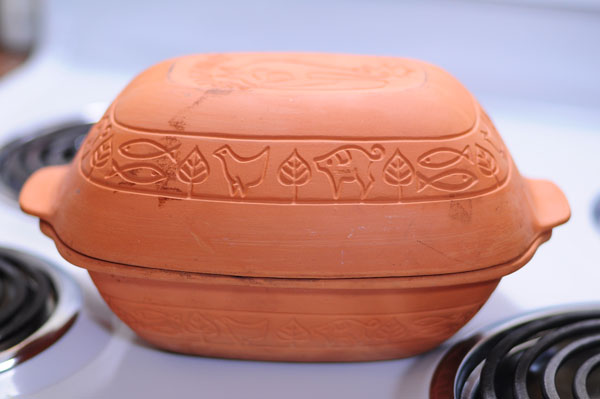
That whole time I was checking out what is available on eBay. Nothing really close to a cloche specifically for baguettes, but they do have lots of clay bakers for chickens, roasts and such. Not really the right shape so I debated internally while time elapsed. Eventually I decided to go with eBay, and I couldn't be more pleased. This closed cloche designed for chickens is perfect for bread, when inverted so to avoid the raised ribs designed to elevate the bird above its juices.

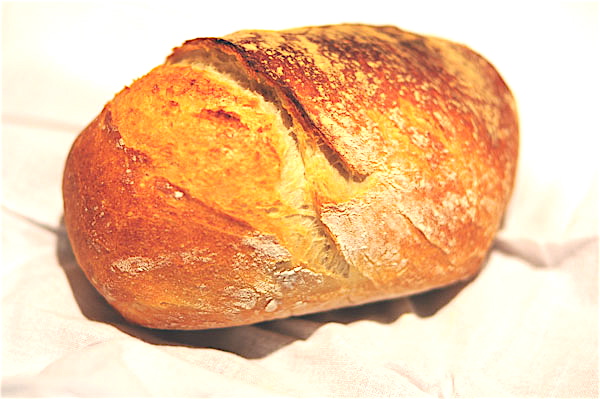
NorthWest sourdough loaf


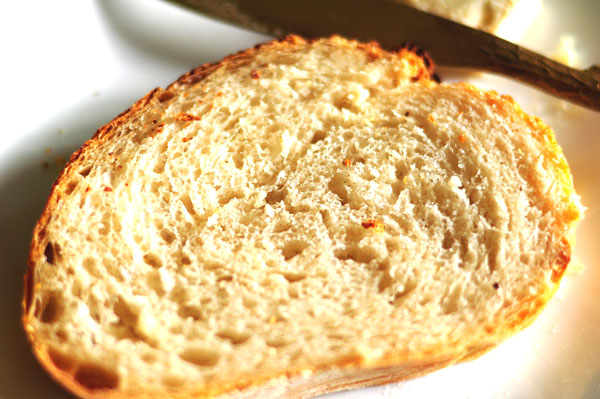
NorthWest sourdough slice